

61. On a new variant of mahjong
I am not an aggrieved victim.

There’s a chaotic and relatively new style of mahjong that’s being played in Changsha, the city I consider to be my ancestral and actual hometown. It operates under rules modified from Changsha-style mahjong, which itself uses only the three main suits with a stipulation that the pair of tiles in winning hands must usually be identical tiles of 2, 5, or 8; in effect, this new iteration is a variation of an established variant.
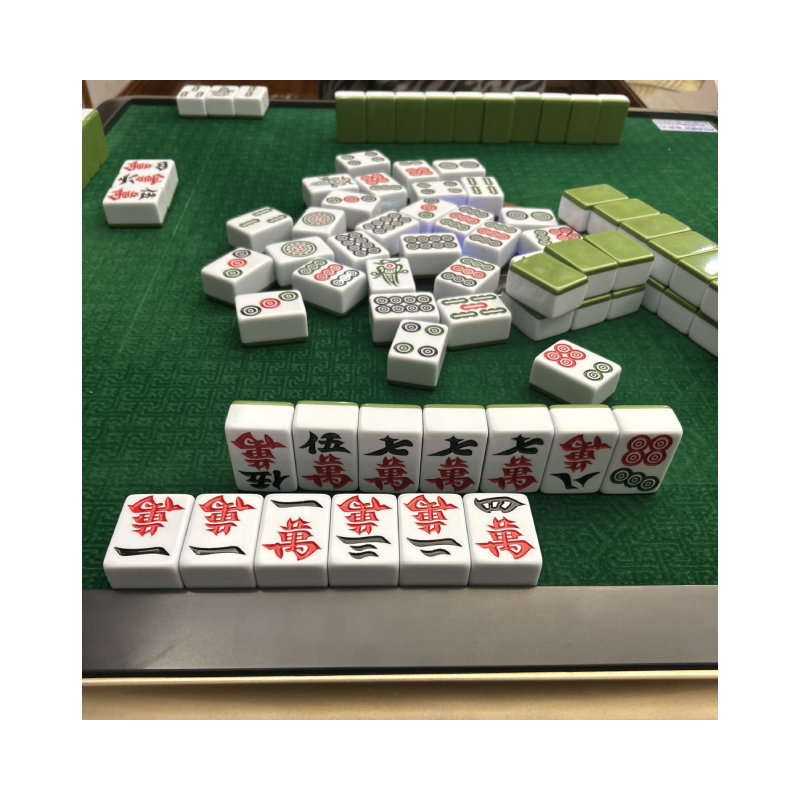
红中麻将 (red zhong mahjong) takes its name from the red 中 tile. It’s typically excluded from play in standard Changsha-style mahjong, but this variation includes it specifically as a wildcard—hence the eponymous name of the game—in addition to other deviations: 吃 (chi), or taking a discard from the preceding player to complete a set of three tiles of the same suit in numerical sequence, isn’t allowed; the aforementioned 2-5-8 rule is permanently suspended; and the winning tile completing a hand can only be taken via pulling from the deck, not other players’ discards. Therefore, players lucky enough to draw a 中 can dramatically accelerate their efforts towards assembling a winning hand, utilizing it to complete any one of the sets of two or three tiles required to achieve victory.
One of my uncles, the nephew of my maternal grandmother, made a point of having me learn red zhong mahjong one night a couple weeks ago as I accompanied him across Changsha in hanging out with his childhood companions, some of whom he has known since they were in primary school together. He relished telling them that I could hold my own in the standard Changsha-style mahjong (and that I could comprehend the local spoken dialect) as he introduced me to them, on which basis he expected that I would quickly master this version of the game. For my part, I was feeling eager to acquaint myself with it, a hitherto unknown yet exciting new adapted form, but I was also apprehensive because I was to learn by playing, trial by error, against seasoned adults who would pull no punches due to there being money at stake.
I left the United States for China in the latter half of March. It was an impromptu trip suggested by a relative who had planned to be in Changsha for just under a month, so it would be convenient for me to go as well. I had last visited back in 2024, when I had plans to spend my birthday touring Shangri-La in Yunnan before extenuating circumstances forced my return stateside. This time, I was determined to make the most of my brief vacation there.
It goes without saying that some of the fun in playing mahjong is attributable to gambling. While it’s true that there’s an element of skill inherent to creating the opportunities to draw what’s needed, that luck is all the more present when given more chances to manifest, it’s the adrenaline rush of winning followed by the happy neurons firing away in the brain as prize money is collected that can make mahjong addictive. However, as I sat for my very first rounds of red zhong mahjong, I was extremely conscious of the 500元 my uncle had given me to serve as my gambling funds. I considered the money to have been borrowed, despite his happy insistence to the contrary, and I was determined not to lose any of it at all; I intended to fully reimburse him at the end of the night. Thus, my learning curve had another layer of anxiety-inducing complexity: not only did I want to expediently become proficient in this new format, I needed to do so to such sufficiency that I would emerge with net pecuniary positivity by surviving unscathed against people who play it on a regular basis.
Although—or because—my uncle hovered cheerily nearby, watching me play and occasionally voicing suggestions, I was nervous. The games moved with great speed as my counterparts drew and discarded tiles as easily as they breathed, but I struggled to consider and reconsider the composition of the tiles in my hand at the same time as I attempted to divine from their rejects the probability of drawing particular tiles remaining within the deck. Every round was a Sophie’s choice, and I did my best to reconstitute my hands towards increased likelihoods of winning, but I erred many times and achieved the reverse.
Each misplay invoked a man’s voice in my head, a memory, chastising me. I learned mahjong very early on as a child, first taught by my grandmother and then my aunts and all of their acquaintances too, and all of these people have played a role in shaping my strategic philosophy—luck can be influenced, statistics must inform tactics, and games can be won even when lost so long as the losses are mitigated. Yet it’s one voice among these many that (harmlessly) yells at me whenever I make a mistake, that motivates me to stay alert during mahjong lest I invite its wrath: another one of my aunt’s friends, a man who I thought of as my gambling tutor because he would allow me to shadow him to games where they bet serious money whenever I was in town. If I wanted to play, he would coach me from the sidelines, always scolding me for not paying greater attention to the maneuvers of the other three players since losing would mean paying out hundreds of renminbi per round. Before and after game sessions, he’d treat me to some of the most delicious meals in Changsha.
My jovial uncle wasn’t like my mahjong tutor, but his advice was similarly successful in getting me to figure out the metagame. We were playing 10元 per game, with additional bonuses of 5元 for each red zhong tile in the winning hand as well as player penalties calculated by looking at the next two tiles to be drawn from the deck. By the time we called it quits around 11 p.m. after four hours of gameplay, I was up 150元. My mind was tired from working overtime, but I was happy to have finished financially solvent. I returned my 500元 seed money to my uncle and tried to press my winnings into his hands too, but he refused on the basis of them having rightfully been won by me. It was pointless to argue with him, but I would later “accidentally” leave behind the cash in his car.
I’ve devoted many paragraphs within my little project here to writing about mahjong, I know, and in my defense I’d proffer that it’s not indicative of me having a gambling addiction. Rather, it’s because I grew up with it as a placeholder activity for community time. It has always been an excuse for family and friends to gather, catching up and trading gossip over the clacking sounds of tile on tile gesticulation, and it’s also how I would come to sadly learn during this trip of my so-called tutor’s recent passing. There’s something to be said about the logically strategic nature of the game, about the way in which satisfying wins seem to scratch a very specific itch within my brain. It’s my favorite pastime every time I return to my old stomping grounds, and it costs me nothing to admit that this is also because it makes me feel connected to a culture and heritage from which I fear becoming increasingly separated.
Weeks ago, I arrived in Changsha at midnight. After twenty-something hours of travel, I’d finished reading the Britney Spears memoir and my limbs were exhausted from being cramped. My flight path had taken me from New York to Los Angeles to Shanghai to Changsha’s Huanghua International Airport, to which China Southern Airlines used to operate direct flights from Los Angeles until the coronavirus pandemic dictated otherwise. The first thing I did upon landing was grab our checked luggage from the carousel; the second was assist a man visiting from Somalia by translating his questions into Chinese for the overnight employees. (He’d been told there was a Kentucky Fried Chicken within the airport nearby and wanted to know where. The employees directed him to the shop around the corner.)
Eating anything late at night isn’t a habit of mine—I don’t enjoy the aftermath of feeling sluggish and bloated immediately before bedtime—but it’s a special treat whenever I’m in China. Night markets are commonplace across Asia, and I should have predicted that we’d go to one straight from the airport. We were picked up and driven to a street of late night vendors by my aunt’s best friend, who wanted to ensure that we’d have at least one good 宵夜 during our brief stay in Changsha. There, I replicated almost in entirety the same order of skewers and grilled oysters that I’d had two years ago.
Like an itinerant couch surfer, I alternated between the homes of aunts and grandmothers and other relatives alike. Daytime was devoted to family-arranged sojourns (to museums and monuments and thousand-year-old universities and grandparents’ graves), all scheduled between enormous banquet-style meals wherein I gorged myself on the most enjoyable food I’ve had since…well, since the last time I was in Changsha. I spent a weekend living with my cousin’s grandmother, whose home is conveniently located mere blocks away from the city center. Each morning, she introduced me to a new noodle shop, all of them locally renowned for their cuisine and rightfully so. Even my breakfasts were decadent affairs.


China’s rapid development over the course of these past few decades is a story that’s been done to death, but I still can’t help marveling at it each time I return. It’s one thing to understand it conceptually; it’s another to bear witness in person, contrasting what I could see laid bare before me with what I remember experiencing in my mind’s eye. The vast improvement in food quality is but one such measure, every bite I savored itself a thousand testimonies in accordance. That my aunt simply walked down to the local butcher shop, picked out a few pieces of chicken, and turned that into the most flavorful, golden broth I’ve ever had in under two hours for one of our lunches was illustrative of just how much the local quality of life has changed for the better.
It’s important I provide the context that Changsha is very much not a first-tier Chinese city—that distinction belongs to the likes of Beijing and Shanghai. For this reason alone, I never held expectations of encountering great technologies or urbanity in Changsha as I would in Hong Kong and Shenzhen. However, as I’ve grown and matured, so too has my hometown. An expansive subway system has popped up in the last twenty-something years; trash no longer litters every sidewalk, and public spaces are pristine; massive new megastructures, residential and otherwise, have sprung up everywhere I look. Yet beneath all of the newfound splendor and high-tech facades are a people I still knew in the aggregate, who felt more friendly and familiar to me than any neighborhood in the world bar my home in New York. The lifestyle and the personalities remained the same.
I spent my spare time getting lost in Nanmenkou, Changsha’s central district. When I had free days because we didn’t have enough players for mahjong, I wandered the city center and its surrounding alleyways. I wanted to commit to memory the sensation of being there, to memorialize those fleeting instances of spacetime. In little souvenir shops, I picked up mementos for my friends back home, and then I went to the adjoining stalls next door to indulge in milk teas and freshly fried stinky tofu. I observed from the streets as neighbors gathered in tiny mahjong parlors that were seemingly omnipresent, located on the ground level of every apartment building within a residential quarter, listening to the electronic whirring of their automated mahjong machine tables and eavesdropping on their conversations and breathing in the scents of the food being prepared nearby.
As I immersed myself, I pictured the life I never lived. The museum trip informed me that Changsha has been continuously inhabited for more than 2,000 years, existing at times even as a kingdom, and I pondered what it might have been like to have grown up surrounded by history, among people who don’t consider me to be othered. My happy uncle, during one of my mahjong sessions, told me that I come from a long, local lineage through my grandparents, and I tried to imagine an existence full of untold numbers of relatives and friends and family acquaintances, a true social network not just in name but also in function. These people have all known me since I was born, yet I’ve spent lifetimes an ocean away. To reconcile such possibilities with the reality of my derelict life in America, where my parents had no family and few friends, where society is run costly and inefficiently and not only selfishly but also malevolently, it does beg the question—who would I be had I always lived here instead, unsevered from my ancestry? I thought about my grandmothers in the city core witnessing the rapidity of technological advancement as time raced by, about generations succeeding one another, about my grandfather cursing me with irritated sinuses for a week because I audaciously complained to him of his poor parenting with respect to his daughter, my mother, as I burned paper money for him to spend in the afterlife.
The truth is I’ve never experienced real hardship. My presence in China amounted only to a fantastical experience because the greenback enables me to move with relative freedom, affording me a degree of luxury that may have been at least six times (6.84, as of today) more difficult to achieve had I come of age there. I was romanticizing being peripatetic because I felt the weight of all the years ahead of me at once, worrying once again that I’d screwed up my life beyond repair, beyond recourse. For the majority of people here or there or anywhere in the world, I don’t believe it’s easy to make a living, and so I mustn’t conflate the life of a foreigner with that of a local. I am not an aggrieved victim.
I guess what I have to say is just that I’m thankful. I spent my birthday on the continent of my forebears with people who care about me—me, a singular individual on a planet of billions—and it means something to me that they do. That I don’t disappoint them, that I don’t let them down, it’s all I can do to repay them.